
WHAT WENT WRONG FOR KEIR STARMER
What are the communications lessons behind Starmer’s downfall
So what went so wrong for Kier Starmer? When he won the 2024 General Election, Labour secured a landslide victory and the keys to Number 10 after 14 years of Conservative rule.
At the time, it felt like a changing of the guard. Britain was ready for something different.
But there is an important distinction between being elected because people believe in your vision and being elected because people have had enough of the alternative.
Today’s resignation is a stark reminder of one of the oldest lessons in communications:
Winning power is one thing. Winning belief is another entirely.
And whether you’re running a country, a company or a brand, the same rule applies. If people don’t know what you stand for, they will eventually stop standing behind you.
It started with the election campaign where their biggest message was simply that it was ‘our turn’, that the Conservatives had run out of road and that Labour was ready to govern.
It was time for change.
The problem was there was very little beyond that. The campaign was built around competence rather than conviction and an overarching narrative that felt like: “We’re not the Conservatives.”
Which, as an election strategy, worked. However, as a long-term leadership strategy, it was never going to be enough.
Because once you’re in power, being better than your predecessor (or blaming them for the first year in office) stops being a compelling proposition.
People quickly move on to asking a much bigger question: Where are you taking us?
And that’s where Starmer’s leadership began to unravel. Even today after two years, the one question millions of people still struggle to answer, “What does Keir Starmer actually stand for?”.
Nobody expects a Prime Minister to solve every problem overnight and people can understand and even forgive difficult or unpopular decisions.
What they struggle to forgive is uncertainty. At a time when household budgets are under pressure, public services remained stretched and economic confidence is fragile, the country needed clear direction – in a way that Tony Blair gave in 1997.
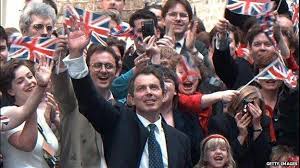
Tony Blair had a clear vision and message in 1997
Instead, many voters were left trying to connect the dots between a series of policy announcements, reversals and compromises. Without a bigger narrative, every decision can begin to feel reactive and rushed.
Every government changes its mind. In fact, I believe good leaders should adapt when circumstances change and not get hung up on Today Programme questioning around U-turns. However, the issue is not the U-turn itself but the reason and a clear understanding of why it’s happening.
Throughout Starmer’s premiership, several policy reversals created the impression of inconsistency rather than strategic flexibility. Importantly, because there wasn’t an obvious overarching vision, changes in direction often felt disconnected from a bigger plan. That’s a communications problem as much as it is a political one.
Competent Strong leadership
Strong leadership follows a simple formula: Vision → Strategy → Decisions.
Too often, Starmer appeared to be communicating in reverse: Decision → Explanation → Damage limitation.
When leaders skip the vision, they force audiences to do the hard work themselves and audiences rarely fill in the gaps in your favour.
Competence is no longer enough, whether you are better than the predecessor or competitor, we’ve entered a new era where competence has become the minimum expectation, not the differentiator.
People expect leaders to be capable, they expect them to be organised and they expect them to be prepared but what they’re actually searching for is something else entirely:
- Direction
- Clarity
- Purpose
- A reason to believe.
Leadership is ultimately a communications exercise. The most effective leaders are often those who can articulate one simple thing: What future are we building together?
It’s why people remember slogans and narratives long after they’ve forgotten policy details.
‘Take Back Control.’
‘Get Brexit Done.’
‘Make America great again.’
Love them or loathe them, they were memorable because they answered a question and tell people where they were heading. It’s much harder to identify an equivalent phrase that defined Starmer’s Britain.
The lesson for business
Too many organisations make the same mistake. They communicate what they do rather than what they stand for. So often we hear clients suggest messaging that includes:
- We’re experienced.
- We’re trusted.
- We’re innovative.
- We’re customer-focused.
They are statements, not a story (and pretty obvious statements too as one would expect a business to be trusted and customer focussed!). The businesses that cut through are the ones that answer three simple questions:
- Why do we exist?
- Where are we going?
- Why should anyone come with us?
If you can’t answer those questions in one sentence, you’re asking your audience to do the heavy lifting and that rarely ends well.
Seven Prime Minister in ten years
That statistic alone should concern all of us. It speaks to a wider issue than party politics as it points to a growing frustration with leadership itself. At a time when the world feels increasingly uncertain, people are desperate for consistency. They are content if it’s not perfection and even better if it’s more than an ideology – but what we want to get behind is a clear direction.
Whether you’re leading a government, a global brand or a small business, people need to know where they’re heading. Because uncertainty is easier to tolerate when there is a destination. Without one, frustration grows quickly.
The takeaway? Leadership is storytelling.
Keir Starmer may ultimately be remembered as a decent, hard-working and fundamentally well-intentioned Prime Minister. But history is often less interested in intentions than it is in impact.
And his greatest challenge wasn’t necessarily policy, it was narrative (and a bit of delivery!). For communications professionals, that may be the biggest lesson of all. If you don’t define your story, someone else will. And once people stop understanding what you stand for, it’s only a matter of time before they stop standing behind you too.
If you are looking for some strategic communications advice, contact the Source PR team.