Tag Archive for: media

Why good PR is about spotting opportunities, not waiting for them

When many businesses think about PR, they often assume it is simply about sending a press release when there is something to announce.

In reality, good PR is far more strategic than that. It is about identifying opportunities, shaping stories and making sure a business stays visible in the media throughout the year.

At Source PR, our role is not just to share news when it happens. It is to constantly look for opportunities to turn everyday updates, initiatives and milestones into stories that journalists will want to cover.

This means balancing two important parts of PR. Creating stories for our clients and responding quickly when relevant media opportunities appear.

Turning everyday updates into media stories

One of the biggest misconceptions about PR is that businesses need a huge announcement before they can speak to the media.

In truth, some of the most successful stories start with updates that businesses might not immediately recognise as news. A local partnership, a community initiative or a development milestone can all become strong stories with the right angle.

For many of our clients, the majority of media coverage comes from ideas developed by our team rather than waiting for an opportunity to appear. By looking at what a business is doing through a PR lens, we can identify angles that are relevant to journalists and their audiences.

For example, a client may simply be supporting a local initiative or charity. While this may feel like a small update internally, positioning it as a story about community investment or local impact can make it highly relevant for regional media and their readers.

A strong local angle often works particularly well, especially with regional publications that are looking for stories that matter to their communities.

Creating PR opportunities through seasonal moments

Another way we keep stories flowing throughout the year is by connecting them to seasonal moments, awareness days and wider trends.

These moments provide a natural hook for a story and allow businesses to join conversations already happening in the media. Whether it is linking an initiative to a national awareness day or building a story around a seasonal theme, these opportunities help keep clients visible across different times of the year.

Of course, many businesses use the same awareness days, so the key is finding a unique angle that makes the story stand out.

Responding quickly to journalist requests

Alongside creating stories, another important part of PR is monitoring opportunities from journalists.

Throughout the working day we regularly check journalist request platforms and media alerts to ensure we do not miss relevant opportunities for our clients. When a request appears that fits a client’s expertise or offering, we respond quickly with a tailored pitch and supporting information.

Because we already have background information and materials prepared for our clients, we are able to move quickly and position them as relevant contributors to the story.

Being able to react quickly is often what helps secure coverage, particularly when journalists are working to tight deadlines.

Why identifying a good story is not always obvious

One of the most valuable roles a PR professional plays is helping businesses understand what actually makes a story interesting to the media.

Often businesses want to promote updates that feel significant internally but are not particularly newsworthy from a media perspective. Installing a new piece of equipment or running a standard promotion might feel important for the business, but if hundreds of other companies are doing the same thing, it is unlikely to stand out as a story.

At the same time, businesses are sometimes sitting on genuinely interesting information that they assume is not worth sharing.

This is where PR experience becomes valuable. By understanding how journalists think and what audiences are interested in, a PR team can identify which updates have real story potential and shape them into something that resonates.

Sometimes it is simply about asking one question. Would the average reader find this interesting or useful?

Building relationships with journalists

Strong media relationships also play an important role in successful PR.

Many of our clients operate in the North West, which means we regularly work with regional publications and journalists who cover the areas our clients operate in. Over time this builds familiarity with the types of stories that work well and the information journalists need.

The same applies to national media. Responding quickly, providing useful information and understanding what journalists are looking for helps build trust and can lead to further opportunities in the future.

A proactive approach to PR

Ultimately, good PR is about being proactive.

It is about constantly looking for the next opportunity, identifying stories that might otherwise be overlooked and ensuring businesses are ready when journalists are searching for sources or case studies.


By combining proactive storytelling with reactive media opportunities, PR helps businesses stay visible in the press and part of the wider conversation.

And often, the best stories are the ones businesses did not realise they had in the first place.

Investigating How PR Helped Labour To A Landslide Win 25 Years Ago

Believe it or not, it is possible to see exactly where ‘Cool Britannia’ reached its high watermark.

It wasn’t at the Trainspotting film premiere or the 1996 Brit Awards, it was in fact at Downing Street of all places.

Why? A transformed Labour Party had just swept to power with an historic election win under its, at the time, charismatic leader Tony Blair.

In the wake of this victory, the new Prime Minister held a drinks reception at Number 10, which saw him host the great and the good of British society.

A now infamous image of him shaking hands with Noel Gallagher emerged from the bash which came to symbolise the unlikely fusion of politics and culture that took place in the mid-1990s.

Between Tony Blair’s election as leader in 1994 and the eve of election three years later, Labour had manoeuvred themselves into a position where they had become inextricably linked to the burgeoning Cool Britannia movement and subsequently the party of hope.

The movement symbolised optimism, hope and new beginnings and was sound tracked by Britpop and characterised by a rare self-assuredness in British culture, highlighted by Trainspotting’s warning to Hollywood that ‘their time was up’.

So how did PR help Labour to victory?

Past PR Failures

 It was no accident that Blair’s Labour found themselves at the heart of this.

Spearheaded by former journalist Alastair Campbell, the party employed a communications and PR strategy that centred on a consistent message of ‘newness’, positivity and the prospect of a ‘new dawn’ for the country.

However, having such a well-oiled media machine was a novelty for the party.

In the 1980s, Labour became synonymous with defeat, after losses in 1983 and 1987. Frankly it needed a brand overhaul.

During the eighties, the ‘Red Wedge’ movement, which saw figures such as Paul Weller promoting the party, seemed to be the perfect PR opportunity but ultimately it failed to translate to election success.

By 1992, however, election success was a real possibility after the Conservatives were deemed responsible for economic failures and Labour responded with the slogan ‘It’s Time for Labour’.

Despite party confidence, victory once again eluded them. This was, in part, down to a huge PR gaffe as reports emerged that a Party Election Broadcast about a sick little girl was fraudulent and this led to ethical questions in the media about the PEB, which damaged the party’s prospects.

The gaffe, known as ‘Jennifer’s Ear’, was a turning point in the election and cost them and the party’s incoherent public relations strategy was floundering in comparison to the Conservatives’ campaign.

With advertising giant Saatchi and Saatchi, the Conservative Party produced a series of slick and powerful billboards such as the famous boxing gloves image claiming a Labour government would bring in a ‘double whammy’ of higher prices on one hand and higher taxes on the other.

The Conservatives’ scare tactics warning against a Labour government worked well and many political commentators opine that the former’s victory was merely as a result of the electorate’s lack of trust in the latter.

Emphasising A ‘Newness’

 From the 1994 election onwards, Blair and his team set about re-branding the party to distance themselves from the past election failures and showcase to the electorate that this was the party of the new century.

With Campbell onboard as a relatively unknown campaign director, Labour had a clear and strategic message which helped them to re-brand.

This was obvious from the outset as in Blair’s first party conference speech as leader, he included the slogan ‘new Labour, new Britain’.

‘New Labour’ would be central to how the party marketed itself and it has been claimed by Blair that it was Campbell who coined the name.

‘New’ was the key buzzword for Labour in their campaigning, highlighting themselves as a modernising force that was in sharp contrast to the Conservatives, who they framed as antiquated and out of touch.

This strategy was key to how they would cast themselves alongside the Cool Britannia movement. In fact, they thrust themselves into the movement at the 1996 Brit Awards when Tony Blair presented the Outstanding Contribution award at that year’s ceremony.

Presenting this award was an opportunity that Blair took to position he and his party as relatable and a far cry from the culturally out-of-touch politics of old.

Cool Britannia symbolised a positivity in the light of the new millennium that was similarly exalted by Blair and his party who rode this wave perfectly.

By emphasising a ‘newness’, Labour were able to position themselves as synonymous with the cultural powerhouses of the time and seemed to offer hope to the electorate, while framing the Conservatives as the polar opposite.

With the D-Ream hit ‘Things Can Only Get Better’ sound tracking the party’s campaign, this newness and fresh-thinking made the public think that things really could only get better.

Getting The Message Across

Back in 1992, the tabloids had waged a war on Labour, denouncing them at every turn.

The Sun were the most vehement opponent of the party, producing infamous headlines such as ‘If Kinnock wins, will the last person to leave Britain turn out the lights?’.

However, in the five years that followed, the party had been able to woo journalists and courted moguls such as Rupert Murdoch into supporting New Labour.

This meant that having once been the denouncer of the party, Britain’s biggest newspapers The Sun and Murdoch’s other red-top The News of the World, were now ardent supporters of New Labour.

Not only did they have the press onside but as part of a new centralised comms organisation at Millbank Tower, New Labour’s message was a unified and well-oiled one, unlike days gone by when it could often be confused and fragmented.

These two factors combined helped the party to deliver key, coherent messages to the electorate about their competencies and deflect attention away from the Conservatives scare-mongering of the ‘new danger’ of New Labour.

Their campaign director Alastair Campbell, a former journalist himself, understood the mechanics of the media and he employed clever soundbites and, the now much maligned, spin to ensure that Labour’s message was clear and positive.

Using the media in such a way, along with centralising communications, meant that the party could communicate to the electorate that they could be trusted on issues such as the economy and crime, with their slogan ‘tough on crime, tough on the causes of crime’ proving effective.

It Was PR Wot Won It

 While the famous Sun headline ‘It was the Sun wot won it’ celebrated a Conservative victory over Labour in 1992, the very same paper was celebrating the reverse result in ’97.

A huge part of Labour’s election win 25 years ago, was down to its ability to communicate and using the media to its advantage.

It also rode the wave of optimism and hope in Britain that was propelled by Britpop, Brit Art a burgeoning film scene and maybe even England’s success at Euro 96 and positioned itself front and centre of this.

This created the perfect electoral cocktail that was guzzled by a triumphant party just as, as they claimed, ‘a new dawn ha[d] broken’.


Featured image from Flickr: https://flickr.com/photos/axeley/2526998419/in/photolist-4RiwAg-2kWs6ka-MFQhcH-bs3QPm-7iTDku-bs3QEw-8Gkni8


In-article image from Flickr:  https://flickr.com/photos/scottishpoliticalarchive/5181666183/in/photolist-8TToQ8-z7wUJ-4uVxGe-BEC2K-4nFaBr-4nTWc3-z7wt7-z7wrB-7UfLqj-dN9PeL-4nCuTF-3nECci-ASNx5z-BECz3A-4oeqC5-rRRkKQ-4oamyz-4nCuT6-YfBeRg-3nK7JU-3nK7EC-3nEChe-YsX4TT-YcWy3s-95o86E-5RUeW4-4D5JXx-9VdpLH-wu7w43-cAUExd-agCYsg-7Ucvur-7Ucv44-5gwtK8-YuHPaB-2jBMsYK-avHLUm-8u3rbV-2h9sdZ7-2h9sdVV-2h9pDCH-2h9sdP2-2h9sdXD-2h9rprA-2h9pDxH-2h9pDBa-2h9rpvD-2h9rpFZ-dyWDSd-2gM3d

HOW HAS THE WAY WE CONSUME NEWS CHANGED?

There are no two ways about it: the way that we get our news has changed over recent years. Accelerated even more so by the pandemic. More than once last year, simply popping out for a paper was not allowed, forcing more of us to consume content online than ever before. At The Source, we are advocates of the #BuyAPaper campaign and are not ignorant of the value of regional print coverage. It’s still an incredibly crucial source of local news. However, it is also important to recognise that the way we get our information is not the same as it was 20, 10 or even 5 years ago. But what does this mean for PR?

Breaking News: We Don’t Always Get Our News From The News

Social media has become really important in the last decade, now, not only is it a resource for connecting with friends, but it’s also a place for learning, venting, creating and most importantly to us – consuming news.

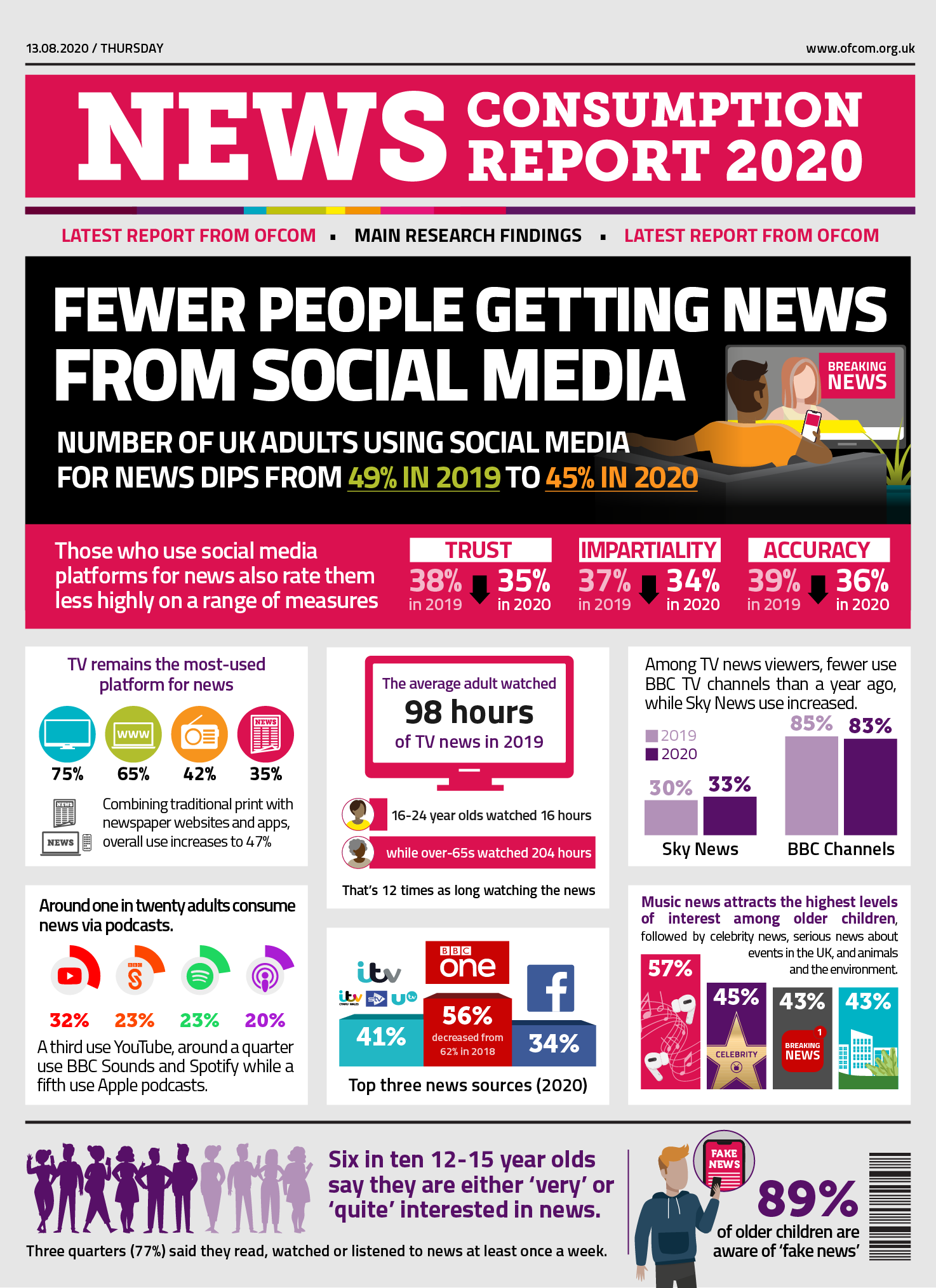
Around 45% of people say they get their news from social media, which is probably much higher than many would have thought when you consider various the demographics of the UK and the number of ways that you can actually get news such as radio, TV, newspapers and online websites.

Image credit: Ofcom

Apparently, gone are the days where you’d pick up a paper or switch on the 10pm news to find out what’s happening in the world. Thanks to smartphones and social media, we now have everything we could ever need to know at our fingertips. This has been highlighted even more so throughout the Coronavirus pandemic.

Recently, weekly reports from Ofcom have been analysing how the UK population has been getting its news through the Coronavirus crisis, unsurprisingly around 83% use traditional media to find out new information, but only 65% say it’s their most important news source.

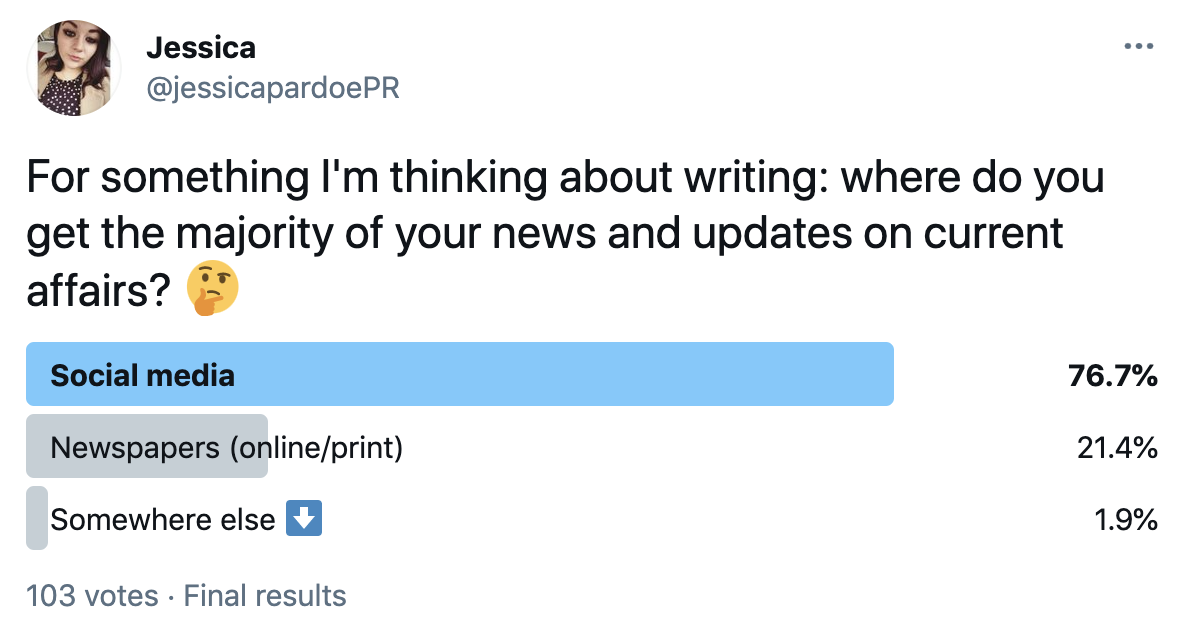
We thought we’d put all this information to the test and find out in real-time how people are getting their news in 2021. The results show that whilst traditional media outlets are still valuable, social media is fundamental to most as a way of keeping up to date with current affairs and local news.

Of over 100 respondents, a staggering 76.7% said that without question, social media was their primary source of news and updates.

News Consumption Survey 2021

What Does This Media Shift Mean For PR?

When you run a PR agency, you need to be tuned in to the media landscape and how it changes. Ultimately as PRs our job is to improve the reputation of our clients, and to generate exposure for them on the platforms where this is most worthwhile.

This means that we need to be leveraging the most appropriate platforms for our clients at all times and understand that the way in which news is consumed can – and does – change.

Social media is incredibly important, yet sometimes it can be overlooked in the face of generating tangible PR coverage. It’s great to say you got a client’s community story in the local paper, or a backlink in the national of course, and we’re not saying that this coverage isn’t important. But we also know it’s important to look beyond the traditional methods of PR. Content should be shared in all the relevant spaces, and that includes social media now more than ever. After all, the numbers don’t lie. When your brand has a story to tell, you should be broadcasting it on Facebook, Twitter, LinkedIn, maybe even TikTok, as well as with local and national newspapers.

Will the way we consume news change again in the future? We’re pretty much counting on it. And will we be prepared for it? You can definitely count on us for that.

To find out more about how we build and protect reputations through various PR and marketing methods (that leverage the most up-to-date news sources) then why not get in touch with our team? We’re always up for a chat about what we can do for your business. Reach out via our website now or connect with us on Twitter or LinkedIn.