CALL US ON 01829 720 789
Source PR
  • HOME
  • ABOUT
  • RURAL DIVISION
  • SERVICES
  • RESULTS
  • FAQs
  • NEWS
  • CONTACT
  • FREE PR & SOCIAL AUDIT
  • Menu Menu

Tag Archive for: Digital agency

WHAT WENT WRONG FOR KEIR STARMER

June 29, 2026/in AGENCY NEWS, PR, PRESS/by LOUIS HILL

What are the communications lessons behind Starmer’s downfall

So what went so wrong for Kier Starmer? When he won the 2024 General Election, Labour secured a landslide victory and the keys to Number 10 after 14 years of Conservative rule.

At the time, it felt like a changing of the guard. Britain was ready for something different.

But there is an important distinction between being elected because people believe in your vision and being elected because people have had enough of the alternative.

Today’s resignation is a stark reminder of one of the oldest lessons in communications:

Winning power is one thing. Winning belief is another entirely.

And whether you’re running a country, a company or a brand, the same rule applies.  If people don’t know what you stand for, they will eventually stop standing behind you.

It started with the election campaign where their biggest message was simply that it was ‘our turn’, that the Conservatives had run out of road and that Labour was ready to govern.

It was time for change.

The problem was there was very little beyond that. The campaign was built around competence rather than conviction and an overarching narrative that felt like: “We’re not the Conservatives.”

Which, as an election strategy, worked. However, as a long-term leadership strategy, it was never going to be enough.

Because once you’re in power, being better than your predecessor (or blaming them for the first year in office) stops being a compelling proposition.

People quickly move on to asking a much bigger question: Where are you taking us?

And that’s where Starmer’s leadership began to unravel. Even today after two years, the one question millions of people still struggle to answer, “What does Keir Starmer actually stand for?”.

Nobody expects a Prime Minister to solve every problem overnight and people can understand and even forgive difficult or unpopular decisions.

What they struggle to forgive is uncertainty. At a time when household budgets are under pressure, public services remained stretched and economic confidence is fragile, the country needed clear direction – in a way that Tony Blair gave in 1997.

Tony Blair had a clear vision and message in 1997

Instead, many voters were left trying to connect the dots between a series of policy announcements, reversals and compromises. Without a bigger narrative, every decision can begin to feel reactive and rushed.

Every government changes its mind. In fact, I believe good leaders should adapt when circumstances change and not get hung up on Today Programme questioning around U-turns.  However, the issue is not the U-turn itself but the reason and a clear understanding of why it’s happening.

Throughout Starmer’s premiership, several policy reversals created the impression of inconsistency rather than strategic flexibility. Importantly, because there wasn’t an obvious overarching vision, changes in direction often felt disconnected from a bigger plan.  That’s a communications problem as much as it is a political one.

Competent Strong leadership

Strong leadership follows a simple formula: Vision → Strategy → Decisions.

Too often, Starmer appeared to be communicating in reverse: Decision → Explanation → Damage limitation.

When leaders skip the vision, they force audiences to do the hard work themselves and audiences rarely fill in the gaps in your favour.

Competence is no longer enough, whether you are better than the predecessor or competitor, we’ve entered a new era where competence has become the minimum expectation, not the differentiator.

People expect leaders to be capable, they expect them to be organised and they expect them to be prepared but what they’re actually searching for is something else entirely:

  • Direction
  • Clarity
  • Purpose
  • A reason to believe.

Leadership is ultimately a communications exercise. The most effective leaders are often those who can articulate one simple thing:  What future are we building together?

It’s why people remember slogans and narratives long after they’ve forgotten policy details.

‘Take Back Control.’

‘Get Brexit Done.’

‘Make America great again.’

Love them or loathe them, they were memorable because they answered a question and tell people where they were heading. It’s much harder to identify an equivalent phrase that defined Starmer’s Britain.

The lesson for business

Too many organisations make the same mistake. They communicate what they do rather than what they stand for. So often we hear clients suggest messaging that includes:

  • We’re experienced.
  • We’re trusted.
  • We’re innovative.
  • We’re customer-focused.

They are statements, not a story (and pretty obvious statements too as one would expect a business to be trusted and customer focussed!). The businesses that cut through are the ones that answer three simple questions:

  • Why do we exist?
  • Where are we going?
  • Why should anyone come with us?

If you can’t answer those questions in one sentence, you’re asking your audience to do the heavy lifting and that rarely ends well.

Seven Prime Minister in ten years

That statistic alone should concern all of us. It speaks to a wider issue than party politics as it points to a growing frustration with leadership itself. At a time when the world feels increasingly uncertain, people are desperate for consistency.  They are content if it’s not perfection and even better if it’s more than an ideology – but what we want to get behind is a clear direction.

Whether you’re leading a government, a global brand or a small business, people need to know where they’re heading. Because uncertainty is easier to tolerate when there is a destination. Without one, frustration grows quickly.

The takeaway? Leadership is storytelling.

Keir Starmer may ultimately be remembered as a decent, hard-working and fundamentally well-intentioned Prime Minister. But history is often less interested in intentions than it is in impact.

And his greatest challenge wasn’t necessarily policy, it was narrative (and a bit of delivery!). For communications professionals, that may be the biggest lesson of all.  If you don’t define your story, someone else will. And once people stop understanding what you stand for, it’s only a matter of time before they stop standing behind you too.

If you are looking for some strategic communications advice, contact the Source PR team.
https://www.sourcepr.co.uk/wp-content/uploads/2026/06/KS-Worried.jpg 1007 1500 LOUIS HILL http://www.sourcepr.co.uk/wp-content/uploads/2018/04/Header-Logo-2.png LOUIS HILL2026-06-29 10:16:392026-06-29 10:16:39WHAT WENT WRONG FOR KEIR STARMER

PR ADVICE – CAN DEMOCRACY SURVIVE WITHOUT INDEPENDENT MEDIA?

January 22, 2021/in PR/by LOUIS HILL

Anyone offering PR advice to Donald Trump must have earned their corn attempting to manage his messages or even keep control of his diverging news agenda. The difficulty of offering PR advice to Donald was that, on average, the Whitehouse Director of Communications lasted just 150 days, barely enough time to effectively influence the strategy, direction or messages let alone establish working relationships with the media.

The Trump Effect On The Changing Media Landscape

During the latest presidency we have also seen a further dramatic shift in the media landscape with the emergence of ‘fake news’, direct communications through social media platforms such as twitter and a growing lack of trust in the media. This is a problem as a free and independent ‘Fourth Estate’, is supposed to hold power to account, an important element in democracy and debate.

The changing landscape has resulted in unprecedented scenes with the need for 20,000 troops to gather in the US Capitol to oversee the safe transfer of power in ‘The land of the free’. This issue has risen largely due to maverick communications and loss of control. Sadly, the storming of the Capitol buildings could therefore be a sign of things to come.

This ability to bypass an independent and regulated media has significant repercussions, particularly if the presiding narrative is that they are trying to steal the election, to not trust the media or the whole establishment. In situations like this where do you turn and who can you trust?

Would Trump Have Fared Better With Good PR Advice?

The need to be held accountable or to win an honest argument no longer applies, as communicating directly through social platforms is proven to be more effective. In Trump’s case he had more than 88 million followers on Twitter – considerably more than the readership of all the major US news outlets combined.

The net result however is illustrated by a poll in December that shows that 40% of Americans did not believe that the election was fair. This is further compounded as nearly 75% of those who voted Republican feel the election was stolen. This is despite the fact the mainstream media reported that 60 post-election lawsuits in multiple states all found that there was no fraud and that the result was fair. Logical debate is simply stifled by volumes of unproven and often unprovable claims.

It’s clear that the trust has gone and that the media are no longer seen as fair and independent reporters of the truth. The ‘lies and denies’ have gained traction and land on fertile ground particularly when communicating to an audience of followers who have built relationships with you online and who no doubt already replicate and share the same views.

Rebuilding Trust In A Post-Trump-Power World

The media also need to play their own role in rebuilding trust. There is a negative spiral occurring where media companies are not reacting to the changing landscape quickly enough or attracting the investment needed to support quality reporting. There is still a legacy of political influence or grudge bearing which needs to be overcome as it leads to poor journalism and subsequent declining influence / sales and so the cycle continues.

Social media platforms started introduced ‘fact checking’ tabs in Spring 2020 to try and manage the number of misleading claims sprouting on the platforms, but when the claims come from an historically credible source such as the President of the United States then the problems are clear. Again it comes down to who to trust – who do you believe? The large tech firms determining what’s accurate or not, the President of the US, commentators or the media?

The Wider Impact On The World

When examining the issue in context of the coronavirus pandemic the problem continues. For example, currently opinion on the vaccine is divided – with some keen to take and roll out while others believe that it’s all part of a wider conspiracy as a result of information they have listened to online (ranging from Bill Gates to 5G conspiracies). The net result however is that nearly two thirds of Americans suggest that they won’t take the vaccine right away, presenting a significant health risk to the country and an even slower recovery and return to normal.

The answer however is not to ban certain users as tech giants themselves are not regulated enough to determine who has the right to opinions. Don’t get me wrong, I believe that anyone making comments on social media platforms should be held accountable but the right to the first amendment must be paramount. That does not negate the option to prosecute racist, homophobic or inflammatory comments or to give temporary or increasingly long bans if users continue flout the rules / laws.

By determining who uses their platforms sets a precedent that may come back to bite social media companies. What happens when they are pressured to ban individuals due to one off political or cultural views or even non-related actions – simply because they do not conform to the new normal. It would be a victory for the woke but a problem for debate and therefore ultimately democracy.

The consequences could ultimately put into doubt the future of an open and free internet. How can a handful of tech bosses make decisions on who does and doesn’t have a voice on the internet? If they do then surely they should themselves be open to more scrutiny?

Where does it all stop? The ‘wokeball’ effect is already taking place with other platforms being pressured into taking similar action with facebook, YouTube and Snapchat also banning Trump. What about holocaust or climate change deniers, devout religious groups, more extreme political parties or even celebrities pushing their own agendas…?

Is Senior Counsel And PR Advice The Answer?

So, what’s the answer? Debating and arguing over differing opinions are as old as humanity itself and are instrumental in a real democracy. Debate needs to be encouraged and media companies should share both the platforms and opinions, rather than ban people or get involved in personal spats where there is a risk they become the story. Media companies should have greater support or regulation in managing their newfound power (already enough to silence the ‘most powerful man on earth’) and commentators / influencers should be open to debate as well as scrutiny.

If offering senior counsel or PR advice to corporates or individuals the same principals should apply. We would always advocate the importance of being honest, to be able to look yourself in the mirror and justify your decisions but most importantly know what you or your business stands for and be consistent to the delivery.

https://www.sourcepr.co.uk/wp-content/uploads/2021/01/Pro-Trump_Rallies.jpg 1493 2400 LOUIS HILL http://www.sourcepr.co.uk/wp-content/uploads/2018/04/Header-Logo-2.png LOUIS HILL2021-01-22 16:09:112021-01-22 16:09:11PR ADVICE – CAN DEMOCRACY SURVIVE WITHOUT INDEPENDENT MEDIA?

WORKING WITH INFLUENCERS IN 2020: EVERYTHING YOU NEED TO KNOW

May 15, 2020/in MARKETING, PR/by SOURCE

According to the annual UK influencer survey, a yearly research piece published by Vuelio in partnership with the Canterbury Christ Church University, there has been a year on year increase in the amount of earned and average income of influencers in the UK – this includes bloggers, vloggers and instagrammers. Today, we wanted to talk to you about working with influencers in 2020, covering:

  • The state of influencer marketing in 2020
  • How to work with influencers
  • Why you should work with influencers

The State Of Influencer Marketing In 2020

According to the findings mentioned above, around 1 in 5 influencers say that it is their main source of income, this is twice as many as in 2016. This tells us that the influencer marketing industry is on the rise, and therefore is still – as ever – a profitable means of generating publicity for your brand (if utilised correctly, which we’ll cover further down).

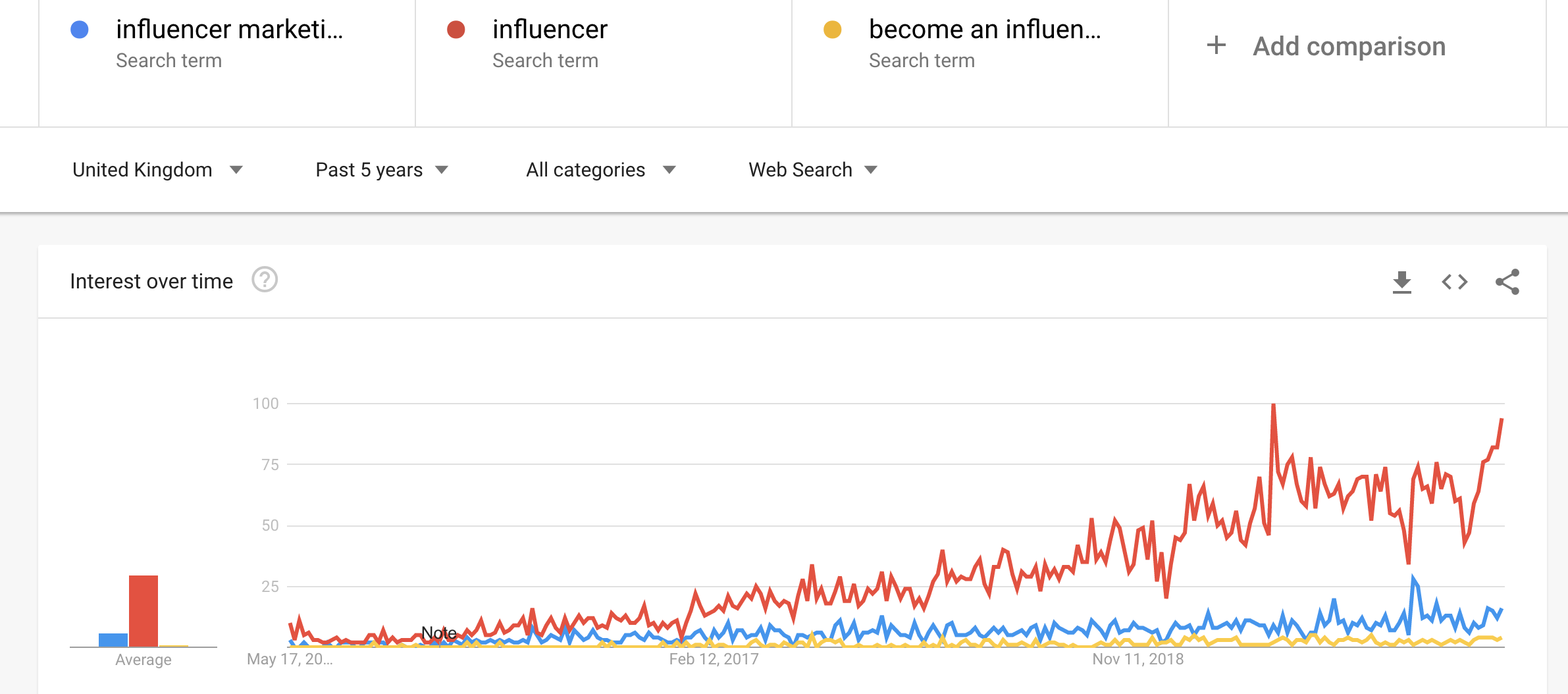
A quick look at Google Trends will also tell you all you need to know about the state of influencer marketing over the past years, ending of course, at the present day in 2020.

Working with influencers - State of the influencer marketing industry

Unprecedented growth in this industry means that influencer marketing is certainly a channel you should be considering in your wider communications strategy, if it suits your brand.

Influencers are operating on a number of channels, the most popular being blogs, but also across social media on Instagram, Facebook, Youtube and even TikTok. The average number of accounts that an influencer runs at any one time is 5, so there’s often a great chance that your brand will be seen by a vast audience and through a variety of media types.

The report from Vuelio also tells us that influencers are posting more frequently than ever before, with the highest percentage of survey respondents saying they post 5 or more times a week – meaning there’s plenty of opportunity for sponsored content for marketers and brands.

Working With Influencers: What Do You Need To Do?

If you’re a brand owner, working with influencers could be a golden opportunity. But how do you work with influencers? There are a few grounds rules that you should follow…

  1. Do your research

Before going out on a whim, do some background research into what kind of influencers you want to promote your product or service. Be mindful, though. Googling ‘fashion influencers’ will often turn up the most popular influencers out there, but these people tend to charge thousands for a single post, that’s if they’ll even consider your brand – if you’re just dipping your toe into influencer marketing, you’ll want to find more mid-tier accounts that have a loyal following but that won’t cost the earth to utilise. You can do this by looking through Instagram and in Facebook groups, or better yet, work with a PR agency with experience in working with influencers, and tell them your goals.

  1. Target the right audience

Be sure that firstly, your brand suits influencer marketing (you can determine this by cross referencing your target audience against demographics of different social media channels). Then, you’ll want to utilise influencers who are based in your niche. The most popular areas of influencer marketing are fashion and beauty, travel and lifestyle – if your brand fits into these sectors than working with influencers is certainly an avenue worth exploring.

  1. Make sensible offers

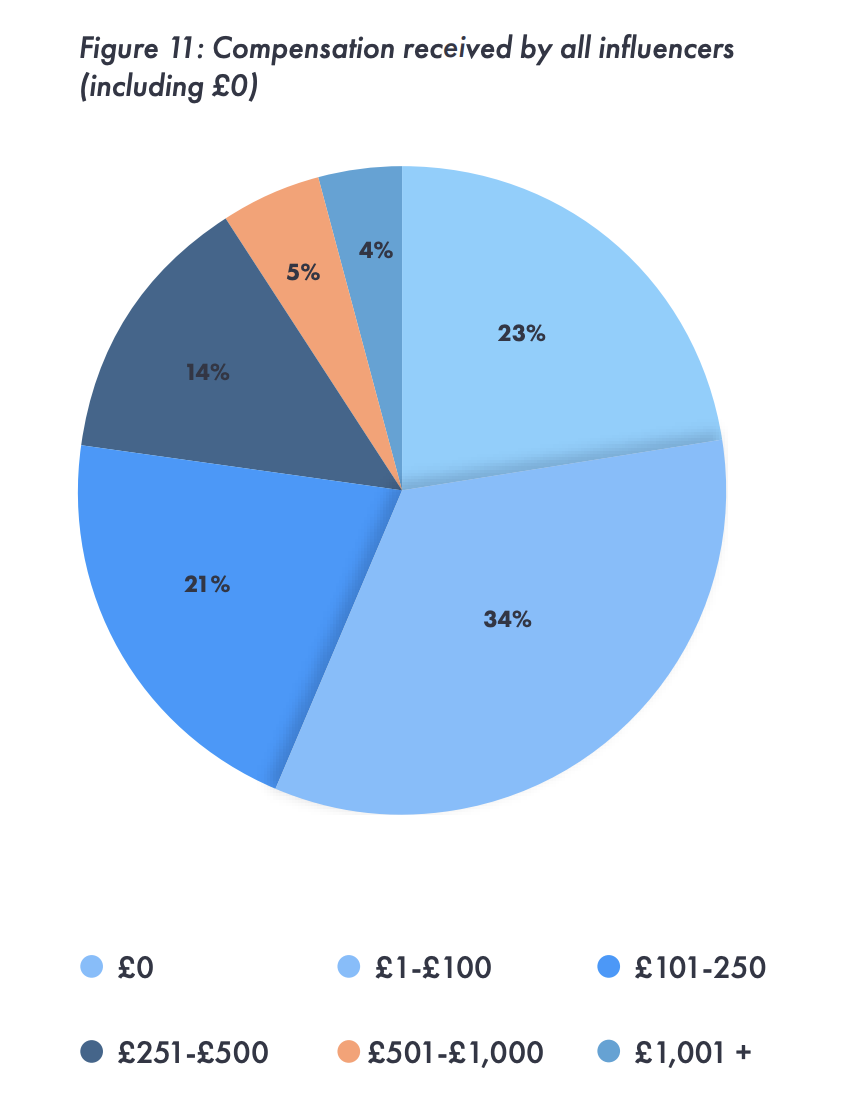
Vuelio’s UK influencer survey found that most influencers received between £1 and £100 per sponsored post, and over half of influencers said they would reject a pitch due to lack of sufficient compensation. Most influencers will promote a product or service for a fair price so long as it is relevant to them. However, you do risk harming relationships if you do not make a sensible offer. Brands will pay influencers different amounts depending on the type of content required, and to answer the question: “can I work with influencers for free?” the answer is yes, sometimes. According to Vuelio, 23% of influencers have produced branded content without any compensation, mainly because the pitch sent to them from brand or PR added value to their audience. Just be careful and considerate when making contact for the first time.

Working with influencers survey

  1. Set goals and follow them

As with any type of marketing, you’ll want to set goals and use KPIs to track them. What do you want to achieve with your influencer marketing? Is it sale of products, brand recognition or simply just more traffic to your website? Once you have defined what you want to achieve from working with influencers, you’ll then be able to work with them on a method that best suits you. It could be a social media post, a sponsored blog or even an Instagram takeover.

Why Should You Work With Influencers?

If your influencer marketing strategy is spot on, then working with influencers can be an invaluable experience for your brand. Why?

  • It can help to grow your following on social media channels
  • It creates endorsements for your products or services
  • It can drive traffic to your website or social media pages
  • It can result in sales of your product of service
  • It can create testimonials for your brand that can be used at a later date
  • It can help build your brand image and by creating a positive association with a prominent person
  • It can help reach your target audience in a new and exciting way
  • It can help find a new audience of potential consumers for your brand

For assistance with your influencer marketing strategy, call us on 01829 720 789 or send us a message for a free consultation, we have affluent experience in working with influencers and will help you open your brand to this modern way of marketing.

https://www.sourcepr.co.uk/wp-content/uploads/2020/05/person-holding-black-samsung-android-smartphone-3850213-scaled.jpg 1707 2560 SOURCE http://www.sourcepr.co.uk/wp-content/uploads/2018/04/Header-Logo-2.png SOURCE2020-05-15 11:47:372020-05-15 19:46:49WORKING WITH INFLUENCERS IN 2020: EVERYTHING YOU NEED TO KNOW

DIGITAL AGENCY – HOW THE TIMES ARE A CHANGIN’

April 9, 2019/in CAMPAIGN, MARKETING, TECHNOLOGY/by LOUIS HILL

When working in a digital agency in Chester and providing B2B PR or consumer PR clients with support and advice, it’s so important to keep up to date with the ever-changing world of new technologies, insights and applications.

Understanding and using new technologies helps keep you at the forefront of providing valuable advice and delivering current campaigns for clients that really work for businesses and customers alike.

If you stand still too long or stop to give yourself a pat on the back, there is a real chance that you’ll get left behind.  It’s fast moving, challenging but when compared to the old days of pure PR – very rewarding.

For years there was always the question of ‘how do you put a value on PR?’  Historically it was a measurement of column inches or messages density, but now there are so many additional factors that should be considered whether it’s directly reaching thousands of customers with engaging messages through social media or producing content that improves a client’s reputation or thought leadership position. Each post or article can be measured in terms of who read it and what action they took as a result.

Digital

With the growth in digital the whole world is more transparent.  The engagement on each post can be measured, the actual number of people who read an online article can be seen and the customer journey for each purchase can be viewed as cookies follow customers through their entire purchasing process.

This is great.  It helps justify marketing budgets and provides a real opportunity to show a return on an investment.  Most important of all is that it makes you realise that you are actually making a difference, that the work you’re creating is driving sales and that the campaigns work.  The times are changing and look set to continue to evolve which has to be great news for clients and digital PR agencies alike – as long as you can keep up.

https://www.sourcepr.co.uk/wp-content/uploads/2019/04/Digital.png 320 320 LOUIS HILL http://www.sourcepr.co.uk/wp-content/uploads/2018/04/Header-Logo-2.png LOUIS HILL2019-04-09 14:02:242019-04-12 14:05:17DIGITAL AGENCY – HOW THE TIMES ARE A CHANGIN’

DIGITAL PR – SIMPLE STEPS TO BUILD PERFECT SITE

December 4, 2018/in AGENCY NEWS, CONTENT MARKETING/by SOURCE

In an increasingly digital world, having a website has never been more important for the emerging brands of today. Whilst the tech-savvy amongst you may already be well-versed with the mechanics of website build, we explore some of the key factors to consider for ensuring that your website is as effective as it can be:

1. Make it accessible

In today’s increasingly fast-paced digital environment, web browsers are looking for quick answers and instant gratification. If your website is clunky and difficult to navigate, a user is quite simply not going to waste their time trying to find out exactly what it is that you offer. Make the message simple and clear from the get-go to grab your reader’s attention. If your message is complex, consider introducing the use of infographics and imagery to make the information more digestible.

2. Make it easy to find

With over 4 billion searches made on Google every single day, it is essential that you consider search engine optimisation (SEO). In layman’s terms, the key to effective SEO is to outline the keywords that you wish your website to be associated with and then to make sure that you are using them effectively throughout the site. A great way to do this is by regularly updating your blog content. This will also show readers that your website is constantly being refreshed and will encourage repeat visits.

3. Optimise for mobile

According to research carried out by TextLocal, 85% of smartphone devices are now used for internet browsing, compared to 72% of laptop devices. This shift in browsing habits means that smartphone optimisation is now one of the foundations for effective website build, as opposed to an afterthought. Where traditionally sites have been optimised for desktop during build, this trend is now changing, and many are now favouring a mobile-first approach in order to enhance the experience for smartphone users.

4. Make it personal

According to research from Accenture (2017), more than one in two consumers (56%) are more likely to shop at a retailer in store or online that recognizes them by name. Capturing customer data on your website provides a fantastic opportunity for personalising the customer experience, from sending birthday wishes through to sending recommendations based on their browsing preferences.

5. Don’t stop improving

Once your web build is complete, the journey doesn’t stop there. Websites need to be constantly monitored and updated in order to perform their very best, and a great tool for helping you to measure this performance is Google Analytics. This tool will breakdown the nitty-gritty details of your site, down to the keyword they used to find you in the first place. GA can work wonders for making those small improvements that will help guarantee that users spend a longer time browsing and engaging with your page.

6. Content is king

If you want your website to appear in the top search engine rankings, content remains king. Google and other search engines will be looking to see what ‘authority’ your site has for the search terms offered. Get the content right, populate with blogs / vlogs and articles that build credibility and authority and secure links to the site. All this helps get the all-important SEO.

If you are thinking about starting a new web project and would like any assistance with the process, then do get in touch with us.

https://www.sourcepr.co.uk/wp-content/uploads/2018/12/Content-image.jpg 571 800 SOURCE http://www.sourcepr.co.uk/wp-content/uploads/2018/04/Header-Logo-2.png SOURCE2018-12-04 15:28:282018-12-04 15:28:28DIGITAL PR – SIMPLE STEPS TO BUILD PERFECT SITE

Latest from Instagram

Follow Us!


CALL US ON 01829 720 789

Scroll to top Scroll to top Scroll to top

This site uses cookies. By continuing to browse the site, you are agreeing to our use of cookies.

OKCookiesPrivacy

Cookie and Privacy Settings


How we use cookies

We may request cookies to be set on your device. We use cookies to let us know when you visit our websites, how you interact with us, to enrich your user experience, and to customize your relationship with our website.

Click on the different category headings to find out more. You can also change some of your preferences. Note that blocking some types of cookies may impact your experience on our websites and the services we are able to offer.

Essential Website Cookies

These cookies are strictly necessary to provide you with services available through our website and to use some of its features.

Because these cookies are strictly necessary to deliver the website, refusing them will have impact how our site functions. You always can block or delete cookies by changing your browser settings and force blocking all cookies on this website. But this will always prompt you to accept/refuse cookies when revisiting our site.

We fully respect if you want to refuse cookies but to avoid asking you again and again kindly allow us to store a cookie for that. You are free to opt out any time or opt in for other cookies to get a better experience. If you refuse cookies we will remove all set cookies in our domain.

We provide you with a list of stored cookies on your computer in our domain so you can check what we stored. Due to security reasons we are not able to show or modify cookies from other domains. You can check these in your browser security settings.

Google Analytics Cookies

These cookies collect information that is used either in aggregate form to help us understand how our website is being used or how effective our marketing campaigns are, or to help us customize our website and application for you in order to enhance your experience.

If you do not want that we track your visit to our site you can disable tracking in your browser here:

Other external services

We also use different external services like Google Webfonts, Google Maps, and external Video providers. Since these providers may collect personal data like your IP address we allow you to block them here. Please be aware that this might heavily reduce the functionality and appearance of our site. Changes will take effect once you reload the page.

Google Webfont Settings:

Google Map Settings:

Google reCaptcha Settings:

Vimeo and Youtube video embeds:

Other cookies

The following cookies are also needed - You can choose if you want to allow them:

Privacy Policy

You can read about our cookies and privacy settings in detail on our Privacy Policy Page.

Privacy Policy
Accept settingsHide notification only