Tag Archive for: media relations

Changes to the media and how they can affect us

The media landscape in the UK (and wider world) is undergoing one of the most profound transformations in modern history. Trust is faltering, traditional audiences are shrinking and social platforms are reshaping how news is consumed and importantly who controls it.

For communications professionals, brands and policymakers alike, the question is no longer whether the media has changed, but where it is heading and what this means for reputation, influence and trust.

Reputation and Trust: A Fragile Commodity

Trust in the media has been steadily eroding for over a decade.  According to the Reuters Institute Digital News Report 2024, just 36% of UK respondents say they trust most news most of the time, a significant drop compared to pre-2016 levels when trust was consistently above 45%.  Trust in news accessed via social media is even lower.

This is a fundamental shift as if you no longer trust the media outlets, why are you reading or consuming their outputs?  Does news then shift to entertainment or as the figures show, people simply turn their backs on them and no longer purchase or engage with it?

During COVID-19, media consumption surged but so did a new found level of scepticism. While outlets were relied upon for daily updates, critics argued that government policy and scientific decisions were not always robustly scrutinised in the early stages of the pandemic. That perception, fair or not, contributed to a broader sense that journalism was failing to hold power fully to account – leading to a further erosion of trust.

Once trust declines, it is notoriously difficult to rebuild. Reputation, like credibility, compounds slowly and erodes quickly.

The Decline of Traditional Readership

When trust is lost a negative vortex is created and that is seen in how print and scheduled news broadcast audiences continue to fall sharply.

  • UK national newspaper print circulation has fallen by more than 50% in the past decade.
  • Regional newspaper circulation has declined by over 60% since 2007 (which is even lower than the heydays of the 1990s).
  • Hundreds of local titles have closed, creating “news deserts” across parts of the UK.

On the broadcast side traditional evening bulletins have also seen steady declines:

  • BBC News at Ten has lost roughly half its audience since the early 2000s.
  • ITV News at Ten has experienced similar downward trends.
  • Younger audiences are migrating away from scheduled broadcasts to online social updates

The 16–24 demographic now overwhelmingly consumes news online, often via mobile devices and social platforms.

While digital audiences are larger, they are fragmented and less loyal. Direct website visits are declining as audiences increasingly access news via intermediaries or take their information from AI (which is notoriously unregulated). Historically people would be aware of the ‘agendas’ or biases of the likes of Rupert Murdoch or Robert Maxwell but with AI it seems less so – although according to a YouGov Poll in July 2025 only 14% of consumers trust AI for providing factual information.

It is increasingly evident that consumers have lost trust in external sources of information and news, which means that they are using their own ‘gut feel’ for whether something is true or not, or seeking validation from peers or influencers who share the same views or principles. This can lead to polarisation of society with individuals falling into and seeking endorsements from their own silo views.

The Social Shift: News via the Feed

The Reuters Institute reports that over 50% of UK adults access news via social media each week. Among younger audiences, that number exceeds 70%.

Platforms such as Facebook, X, Instagram, and TikTok have become primary gateways to news. This creates two major shifts; publishers no longer fully control distribution and that individuals and brands can now communicate more directly with audiences.

The ability to bypass traditional gatekeepers is powerful. CEOs, politicians and organisations can speak instantly to millions without editorial mediation. For PR and corporate communications, this has transformed strategy allowing owned channels to rival earned media in influence.

But it also means scrutiny can be avoided and we are seeing an increasing shift towards politicians or CEOs not being made available for comment – simply because they no longer need to and instead choose to appeal directly to their audiences through their own social channels.

This is best illustrated by Donald Trump.  Having been initially kicked off Twitter / X when he had the ability to communicated with 20m+ followers, he set up Truth Social (where he controls what can and can’t be said as well as who gets a platform!).  Aside from the fact a team of unelected executives could effectively silence the ‘most powerful man in the world’ by deleting his account – he is now back online and regularly communicating to his 8.6 million followers on Truth Social and 110m followers on X.

Let’s just stop and reflect on Donald’s ability to speak directly with 110m followers on X.  Alastair Campbell would have loved this ability to ‘control the narrative’ back in the day when he was managing Tony Blair.  No need to worry about dodgy dossiers or the Today Programme challenging the right to attack Iraq – he could simply share his side of the argument with no scrutiny or even ‘fact checking.

This puts politicians and businesses in a powerful position – but sadly there is simply no independent scrutiny over what is being said.

This seems an unfair fight when traditional broadcasters in the UK are regulated by Ofcom and operate under strict impartiality and editorial codes. Newspapers are also subject to industry regulation and defamation law.

Social platforms, by contrast, operate with significantly lighter oversight regarding editorial responsibility where algorithms, not editors, determine visibility.

This regulatory imbalance is reshaping public discourse.

Algorithms, Echo Chambers and Polarisation

Algorithms are designed to maximise engagement. Engagement often means content that provokes emotional reaction.

Research in both the UK and US shows that algorithmic feeds reinforce existing viewpoints, creating echo chambers. Users are shown more of what they already agree with which in turn leads to ideological reinforcement and, over time, polarisation.

The United States provides a cautionary case study. The polarised media ecosystem leading up to and following the Capitol Hill riots illustrated how fragmented information environments can amplify division.

When audiences inhabit entirely different media realities, consensus becomes harder to achieve which again has led to massive polarisation in the US and even talk of civil war as both sides become entrenched and validated through algorithm feeds.

Clickbait and the Dumbing Down of Content

The issue is further compounded as digital economics reward clicks, shares and dwell time. Headlines are increasingly optimised for attention rather than nuance.

Click-driven models encourage sensationalist framing, over simplification of complex issues and largely outrage-based narratives.  This doesn’t necessarily mean journalism standards have collapsed (although it could be argued that they have) but commercial pressures are undeniably shaping presentation. The race for digital advertising revenue is diluting depth and dare I say even creating a fear of annoying advertisers.

I remember the days when I worked at Marks & Spencer in the early 2000s and the company was under constant attack and scrutiny from the media, while also spending tens of thousands advertising in the likes of the Daily Mail.  At one point a telephone call was made to the Mail’s advertising department to ask them to call off the wolves in the editorial team.  The M&S executive was firmly told of the importance of independent editorial and that they would not be threatened with the withdrawal of advertising revenues.  Sadly, the days are long gone when advertising spend did not influence editorial decisions.

The BBC, Legal Challenges and Trust

Even our old Auntie, the BBC, has lost its way and although it is still one of the most trusted news brands in the UK (according to Ofcom research), it is increasingly facing a decline in confidence.

High-profile controversies, including criticism and lawsuits surrounding coverage of the Capitol Hill riots and documentaries on Gaza, contribute to narratives that the broadcaster is either biased or under political pressure.

When trust is questioned, even without proven fault, reputational damage can linger. This in turn leads to an erosion of public confidence which requires sustained transparency and independence for it to recover.

Direct Communication: Opportunity and Risk

So how does the current media landscape affect organisations?  In short, we believe there is an opportunity.  Companies must work on their own direct audience messaging, using the platforms and relationships that they have available to them, principally social media and their websites.

This engagement must be done in real time as consumers now operate in an immediate landscape whether online ordering and delivery through to the availability of news at the opening of a screen.

Organisations should also look to own their own content ecosystems whether providing valuable content regarding their products and services through to wider industry content that will help position them as leading experts who speak with authority.

Let’s also remember the importance of AI and how more than 60% of searches today are ‘no-click’ searches meaning that customers take their information straight from the AI answer.  Companies need to embrace this and have strategies to feed the AI content.

Finally, remember the importance of influencers.  Historically the media has acted as an influencer, but today individuals can have the same reach and power as newspapers and magazines.  These influencers are just that – able to shape the narrative and influence decisions by connectivity and trust with their own audiences.

But it also brings responsibility. Without traditional gatekeepers, misinformation can spread rapidly. Reputation management has shifted from relationship-building with editors to continuous digital monitoring and building coalitions with partners and influencers who can be called on to help when needed.

A Perilous Point

We are arguably at a tipping point where trust in media is declining in parallel with economic pressures on traditional journalism. Audiences are fragmented across algorithm-driven ecosystems and it is evident that regulation has not kept pace with technological change.

This has all led to greater polarisation both of audiences, opinions and news gathering. This poses a danger, not only because ‘independent’ journalism is declining but because of the effect it has on the shared and trusted information space. An independent, powerful and accountable media has always been the foundation of free and democratic societies.

Put most simply – if audiences cannot agree on facts, public discourse becomes unstable, polarisation builds and societal splits happen.

Where does the future lie?

The above may come across as a little fearful, but this is largely because of the speed of change and consumers ability to keep up as well as the role of regulators. We are already seeing legislation being put in place to better manage social media and let’s hope that more scrutiny is put onto ‘fake news’ and people being held more accountable for what is shared online.

There is no doubt however that the media landscape has changed forever.  The future of media will likely be hybrid, based in stronger subscription models which will allow for better journalism.

Although a liberal at heart, let’s also hope for greater regulatory intervention for platforms to not only protect young people but to restore a basic level of trust.  The growth of influencers may also lead to further growth in independent journalism which if executed effectively could help rebuild trust in the medium.

For media organisations, communicators and institutions alike, the challenge is clear – we need to rebuild scrutiny, restore transparency and prioritise accuracy over immediacy. Because once trust is lost, it is extraordinarily hard to regain.

Since the beginning of time and throughout all this recent change one principle remains constant: trust is the currency of influence.  Without trusted media, we risk losing something far more fundamental.

What’s he going to say next?

Why unpredictable communications matter – and what businesses can learn…

In the modern media environment, unpredictability commands attention. Few world leaders have exemplified this more than President Donald J. Trump, whose communications approach – from speeches to impromptu media briefings – has consistently kept audiences asking the same question: “What’s he going to say next?” At Source PR, we believe understanding this phenomenon isn’t merely political commentary: this communications strategy is case study with lessons for B2B leaders and brands alike.

At its core, President Trump’s messaging strategy thrives on uncertainty. Rather than carefully script every soundbite behind closed doors, he often speaks in a conversational, unfiltered manner that leaves audiences – and often even seasoned journalists – unsure what to expect. That unpredictability is far from accidental. In diplomatic negotiations with world leaders, it functions as a strategy rather than a slip-up. When counterparts cannot reliably forecast his next move, traditional negotiation dynamics change – often in Trump’s favour. Other leaders may hesitate, seek clarification, or make concessions to avoid abrupt shifts, effectively allowing the communicator to shape the narrative from a position of advantage.

That same unpredictability plays strongly domestically.

For large segments of the U.S. public, Trump’s tone and cadence feel authentic precisely because they deviate from conventional political script. In an era where generic messaging and polished speech have dominated public discourse, his bold, unscripted style can feel refreshing and direct to supporters – even if it is chaotic to others. This is a crucial insight: audiences value authenticity, and authenticity often stems from risk, not rehearsed messaging.

However, this approach also raises questions about consistency – a cornerstone of effective communication. For companies and leaders in the B2B space, inconsistent messaging can create confusion among stakeholders, erode trust, and slow decision-making. Markets don’t respond well to volatility; partners and clients value messages that are predictable, aligned, and tied to core strategy. When the world is left waiting to decipher the next message, even significant policy announcements – or key commercial updates – risk being drowned out by speculation and noise.

What's he going to say next....?

What’s he going to say next….?

So is Trump’s communications style a model to emulate?

Not in its entirety. What is instructive is the underlying principle: clarity of purpose matters more than rigid consistency of form. In other words, your audience should understand who you are and what you stand for, even if the way you deliver that message varies by channel or moment.

For B2B communicators, the lesson isn’t to foster uncertainty – it’s to harness authenticity and strategic intent within a consistent framework. Whether you’re addressing investors, industry partners, or media, your narrative should be recognisable, repeatable, and aligned to business goals. Unpredictability may generate headlines, but consistency builds credibility.

President Trump’s communications style is a new benchmark in political messaging precisely because it disrupts the old norms – and reminds communicators that how you speak can be as impactful as what you say. For businesses, the invitation is clear: be intentional about your messaging strategy, know your goals, and always be ready to guide your audience toward understanding why you’re speaking – not just what you say next.

What are the benefits of Community PR

When it comes to shaping your business’s identity, it’s easy to focus on national campaigns or polished digital strategies. But sometimes, the most meaningful connections are forged much closer to home. Community PR isn’t just about sponsoring the occasional event or sending out press releases—it’s about becoming an integral part of the local area and creating relationships that truly resonate with your customers and community.

Why Community PR Is So Powerful

At its heart, community PR is about showing that your business cares. It’s about stepping beyond being “just another company” and becoming a name that’s genuinely woven into the community. Whether you’re supporting a local charity, working with nearby schools, or helping to organise events, these efforts demonstrate a real commitment to the people and places you serve.

The trust you build through consistent, thoughtful contributions pays dividends. In fact, 77% of consumers want to buy from companies they feel are making the world better, and 92% of consumers are more likely to trust a company that embraces CSR. These statistics show the powerful impact community PR can have on your reputation—and your bottom line.

Building Relationships That Work Both Ways

No business exists in isolation. Each one operates within a web of connections—customers, suppliers, and neighbours—all of whom shape its success. Engaging with your local community helps to strengthen these relationships and creates opportunities that benefit everyone involved.

Collaborations are particularly effective. Partnering with local community groups, for example, amplifies your impact and introduces your business to potential customers in a way that feels authentic. Supporting a community sports team, or backing a local event, doesn’t just get your logo in front of people; it shows that your business shares their values.

Word-of-mouth referrals often follow naturally too. There’s something uniquely powerful about a recommendation shared over coffee with a friend or in a neighbourhood group online—it’s genuine and trusted in a way that advertising simply can’t replicate.

Becoming a True Community Contributor

Businesses that stand out are those that actively give back, and not just with cheques or sponsorship banners. The difference comes from rolling up your sleeves and getting involved.

Hosting workshops, lending your space to community groups, or even organising a local seasonal events shows you’re invested in improving the area for everyone – rather than just an exercise in community PR. These actions also humanise your brand, making it feel more like a neighbour and less like a faceless entity.

When people see your business as a contributor to the community’s success, their support becomes personal. And that sense of personal connection is something no marketing budget can buy. And that sense of personal connection is something no marketing budget can buy.

The Wider Benefits

Strong community ties ripple outward in ways you might not expect. Beyond building a loyal customer base, they can also help attract employees who want to work for a company they’re proud of. A business that values its community often draws in people who share that ethos, creating a team that’s invested in more than just profits.

Community engagement also strengthens your relationship with local media. Journalists are far more likely to feature stories about businesses making a positive difference close to home, helping to spread your message even further.

Helping Businesses Make a Real Impact

At Source, we specialise in helping businesses create impactful CSR and community PR strategies. It’s not just about finding the right collaboration—our focus is ensuring it delivers value for both parties.

From identifying ideal community partners to ensuring long-term, mutually beneficial outcomes, we guide businesses in forming genuine connections that align with their goals. Our approach goes beyond surface-level efforts, helping businesses build deeper relationships with the communities that support them—turning sponsorships into meaningful partnerships that reflect shared values and long-term commitment.

Growing Together

Community PR isn’t just an add-on to your marketing strategy—it’s an opportunity to connect and grow in a way that feels authentic and enduring. By taking the time to genuinely invest in the places and people around you, your business becomes more than a brand. It becomes part of the story of a thriving community.

If you’re interested broadening your PR strategies to incorporate meaningful, lasting connections in your community, we’re here to help. With our expert guidance, we’ll help you find the right collaborations and maximise the impact of your community efforts.

Skills You Need To Be A Successful PR In 2023

It’s no secret that working in public relations and managing successful PR campaigns can be a stressful yet rewarding at times. One day you could be pitching in a hot new client story to the media, the next you could find yourself in Milan conducting a video shoot (okay, that doesn’t happen all that often, but it did for me recently, so I had to mention it!). Working in PR, means you get to add many strings to your bow and here, we explore the essential skills that’ll help you to enjoy a thriving career in PR.


Strong copywriting skills

Possibly the cornerstone of any role in PR and comms is solid copywriting skills. A huge part of the role, you’ll need to turn your hand to writing blogs, white papers, reports, press releases, case studies…the list goes on. If you’re in an agency role with several clients, it’s important to nail the tone of voice for each client and have the ability to digest sometimes complex information before drafting it up in an easily readable and understood manner.


An eye for news

A must-have skill in PR is knowing which story is going to hit the sweet spot with the media. In meetings or interviews, being able to pick out those golden key pieces of information that will leave journalists wanting to know more isn’t a knack that should be taken for granted.


Passion

Passion is what gets us through on the hardest days. Maybe you’re struggling to get in touch with a journalist, your social post isn’t performing how you wanted it to, or your event sign up numbers aren’t as high as anticipated – these things can really put you on a downer after weeks or even months of planning and hard work. A dash of passion and desire to do your best work is what is needed to get us through those tricky days!


A thick skin

Unfortunately, like many industries, delivering successful PR isn’t for the faint hearted. You may come across a cranky  (we all have bad days), challenging crisis comms work, or get some unexpected feedback on an article you poured your heart and soul into and it can be dis-heartening. Feeling this way isn’t a bad thing, it just shows we care!

Adaptability

“But that’s how we’ve always done it” isn’t a welcome phrase in our industry. As professionals, it’s important to be able to adapt, change and embrace new trends, techniques and technology. Gone are the days of cutting out individual press clippings and compiling them into a book to then send in the post to clients – and aren’t we glad of that!? If PRs had ignored this new method of communication called social media 10 years ago, then I wonder where we’d be now. Arguably, SEO only became a thing in the late 90s, and look how much that has evolved over the years. For me, there will always be a place for genuine content and print media, but there’s also plenty of room for the newer stuff too!


The team at Source PR have all of these skills in abundance, to find out how we could help you and your business, get in touch.

Crisis PR Management & Another Lesson From KFC

No brand or business is immune to the challenges presented when a PR crisis erupts.  Equally, in today’s digital world, no company can guarantee that a PR crisis won’t happen to them, as such all companies should at least have plans in place to prepare for the unexpected.

Crises typically fall into two camps – internal crises, generated by a business decision, action or fault, or those developed externally either by a changing consumer landscape, political issue or an unforeseen issue with a product or service.

Hopefully effective business planning and preparation should mitigate a PR crisis erupting, so it must be particularly frustrating when an ‘own goal’ is scored by simply being careless and taking your eye off the ball.

This point is perfectly highlighted by the recent PR crisis to envelop KFC.  Earlier this month, KFC sent a promotional message to German customers encouraging them to celebrate Kristallnacht by having extra cheese on their tender pieces of chicken:

“It’s memorial day for Kristallnacht! Treat yourself with more tender cheese on your crispy chicken. Now at KFCheese!”

The issue is that Kristallnacht is widely seen as being the start of the holocaust when in 1938 the Nazis led a series of attacks on Jewish businesses and community that left more than 90 people dead, and widespread destruction of Jewish properties and places of worship.

Kristallnacht (the night of broken glass) is remembered on the 9 November and marked with numerous memorial events and discussions to reflect the Nazis’ murder of more than six million Jewish people.

The PR issue was placed firmly at the doors of their automated push notification that sent the message directly to their customers without human intervention.  The system effectively identifies significant days in the calendar and attaches a promotion to them, before sending to customers.

Daniel Sugarman, Director of Public Affairs at the Board of Deputies of British Jews described the original KFC message as “absolutely hideous” and left KFC having to quickly apologise and re-examine their internal systems to prevent the company from having to manage future PR crises.

The company’s tried and tested crisis PR procedures quickly kicked into place but despite the rapid response, the issue had spread to online national and international news outlets.  The issue was quickly amplified via social platforms, illustrating the speed that a PR crisis can spread in today’s digital world.

This was an unnecessary and bad own goal by KFC.  Even if the business managed to convince its audiences that it was not actually in favour of celebrating Kristallnacht with extra cheese, it exposed the business at the very least as being uncaring, poorly run and single-mindedly promoting sales without due care.

We should really have expected better from KFC, particularly after they were able to turn an externally influenced issue into a master class of crisis PR management.

Back in February 2018, the company’s biggest nightmare turned into a reality when the restaurant ran out of chicken due to supplier issues. The net result was that the company was forced to shut down more than half of the stores in the UK.

How to manage a PR crisis

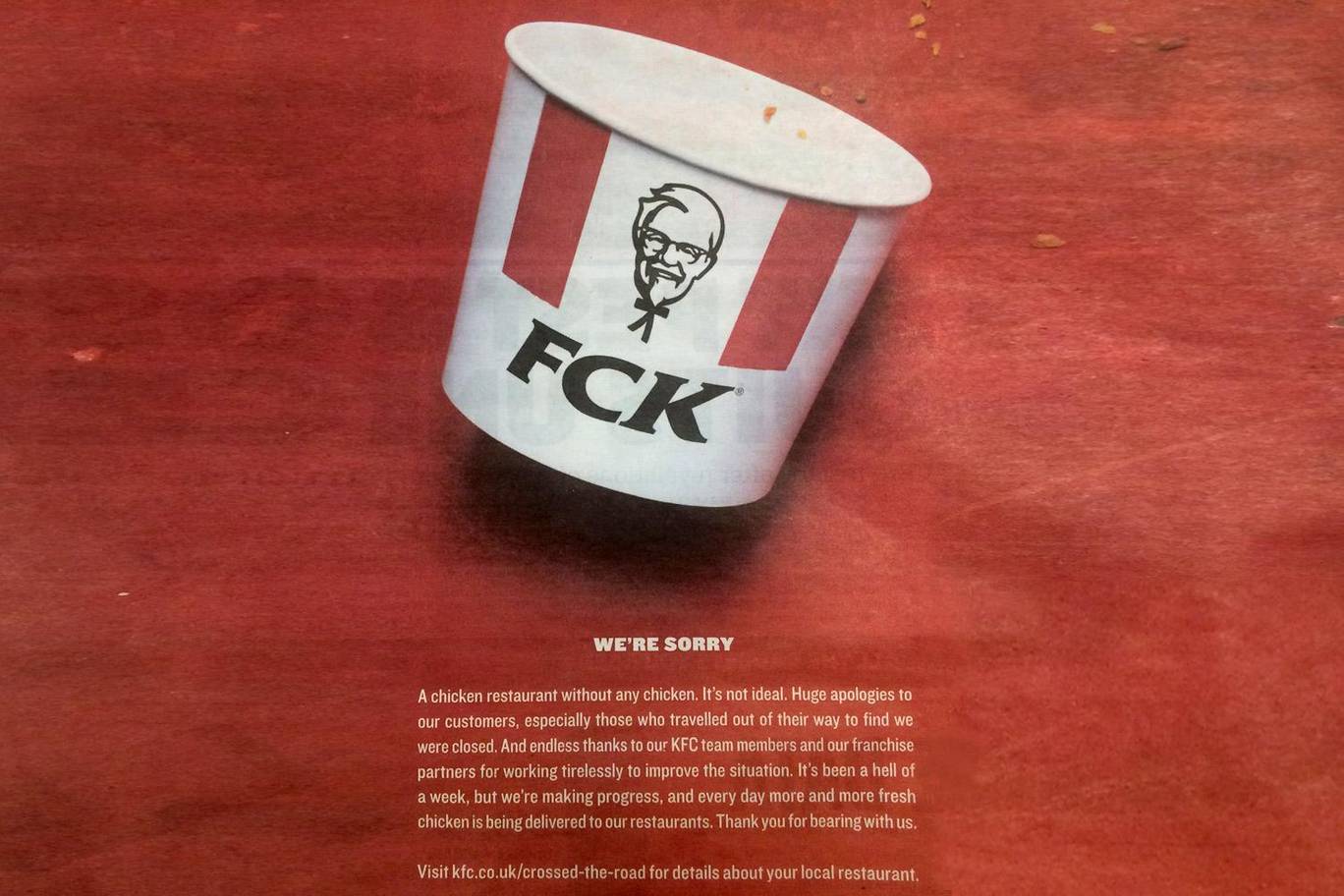
With a crisis PR team, plans and creative thinking in place they were able to turn the issue into a positive PR campaign – saving not only the brand’s reputation but also building relationships with customers and maintaining their trust.  How to manage a PR crisis? They simply followed the plan.

  1. To start, they apologised and made themselves accountable for the crisis.  Rather than attempt to shift blame they apologised to the customers directly via social media channels and newspapers
  2. Secondly, they kept communication open and honest. KFC was very effective at using social media to address customer questions or concerns, even using twitter to share customer Q&As
  3. Finally, by being transparent with the issue, and how they are dealing with it, KFC showed they were taking steps to bring the operations back to normal, with web links sharing information.

The company was also humble and showed gratitude towards its customers for bearing with them and apologised / thanked all the stakeholders for their patience.  Throughout the crisis PR management they kept the emotional balance right.  This involved being apologetic when things went wrong, professional when showing they had the matter under control and yet maintaining a sense of humour in their messaging.

A sense of humour when managing a PR crisis

Finally, they were consistent with their communications and ensured that the issue went to the very top with all messages on social media coming from the fictional KFC’s founder, Colonel Sanders, himself.

It’s clear that PR crises can come quickly out of the blue, from a simple slip up or from an issue that has developed gradually over time.  In today’s digital age, they can erupt more quickly than ever so it’s important to have plans in place.  KFC had a visible presence on social media prior to the crisis and made sure they used it to reach the affected parties.

If you find yourself in crisis or in a similar situation, contact Source PR as we can provide you with hands-on crisis management support or better still help you put a robust crisis management plan in place before an issue arises.

How Much Do PR Agencies Charge?

As we head into what is likely to be another economic slowdown, there is often an uplift in businesses wanting to raise their profile in an increasingly competitive market.  With budgets tight and ambitions high, prospective clients often ask us ‘How much do PR agencies charge?’.

The short answer is how long is a piece of string, as there are a number or variables that can influence the amount PR agencies charge, whether it’s the amount of time spent supporting the account, the specialist nature of the work or the seniority and experience of the team required to deliver the results.

But it’s equally an important question as the predetermined budget is one of the key factors when selecting the right PR agency to support your marketing goals.

Here we’ve tried to outline some of the key elements that go into determining a PR budget, to help prospective clients pick the resource and team they need to support their business ambitions.  Knowing the information will hopefully help internal stakeholders understand why the costs are what they are and the agency is the right one for the business

Before appointing a PR agency, the first question must be whether the company has existing skills and resource available to deliver the plans.  If not, there is always the option to recruit a ‘PR manager’ to help, with typical costs of £35 – £50kpa depending on location, experience and skill set.  If selecting this route, ask whether they have all the required skills and industry resources to deliver the campaign as well as what plans are in place to cover holidays or other absences?

Another option could be to use a freelancer.  Freelancers often cost more than an in-house resource and can bring specialisms and experience, but often deliver tactically the strategy that’s been determined in house. Freelancers have specialities and niches, so if considering this you may need to hire one freelancer to handle your social media while another for media relations.  Costs can range from £150- £250 a day again depending on skills and experience and can quickly rack up if not managed carefully.

Selecting the right PR agency

When it comes to selecting a PR or social media agency, these typically fall into three categories, large, small and specialist PR firms.  Hiring an agency gives you access to a team of experts across the full spectrum of communications services from media relations, social media management, crisis communications, public affairs, SEO and more. Unlike a freelancer, agencies usually offer a team to deliver the strategic planning, measurement and evaluation along with tactical delivery and execution.

Smaller or ‘boutique’ agencies, typically have a staff of less than 20. Their monthly fees usually range from £1,500 – £5,000 (potentially more for a London based or highly specialist firm). The value is in the easier access to senior PR counsel as well as the agility and close working relations built with the team. Boutique firms can also specialise in specific sectors and services within the PR and marketing spectrum but offer a more personalised service to client businesses.

Large agencies usually have staff of more than 20 and have offices across the UK or world, offering support to clients that require that reach. Some of the brand names like Edelman, Weber Shandwick and Hill and Knowlton fall under this category. These agencies cost the highest with typical retainers more than £5,000 per month. These agencies are best suited for big corporations and governments, especially those needing PR support for multi-national launches and campaigns.

When it comes down to working out how much do PR agencies charge, most PR and social media agencies operate either on a project or retained basis.  Project rates tend to be for shorter term contracts between one and three months and can be used to support an event or crisis.  Project-based contracts tend to be priced higher than annual retainers because agencies spend a lot of time in winning the business, researching the company and getting to understand the various products or services. The short-term aspect can also put a lot of pressure on the agency’s resources to deliver within the time frame and the time spent on learning the account cannot be recuperated six months down the line once the project has ended.

Retained contracts run longer and are usually around 12 months duration, however at Source PR we are proud to say that we have supported several clients for more than 10 years on a rolling retained basis (as they value the work and results we deliver!). Retained contracts often cost lower than project-based contracts because the time spent and the research done in the initial few months by the agency are paid off in the long-term.

PR Agency Services

Services like media relations are offered on retainer contracts because the best results are achieved in the long term.  A one-off press mention in top-tier media can lead to a short spike in brand awareness or traffic to a website, but only consistent press coverage over the long-term will genuinely build and enhance a company’s brand and reputation.

Retained contracts typically allow clients to pay a fixed rate every month based on a specified scope of work or a fixed number of hours. Some months the work may be slower but it is usually balanced by months when the workload is higher.

One of the key influences into PR agency prices is based around the team allocated to support the business.  PR prices are proportional to the agency day rate card (i.e. how much time a member of the team would be required to support the business and the seniority / experience of the person or team). Naturally the hourly rate of an account executive is lower than that of an account manager, which is lower than that of an account director etc.

When looking to choose a PR agency, it tends to be best to work with a firm whose typical client is of the same size and budget as yours. Some clients with moderate budgets make the mistake of selecting a ‘big name’ agency only to have junior or less experienced PR staff working on the account as the client (or fees!) are not deemed as important to the senior team.  Smaller or boutique agencies typically give better access to the senior team at a more affordable rate.

Finally, one of the other key influences in determining ‘How much do PR agencies charge’ comes down to the services required by the client.  Some services like strategic planning, branding and public affairs understandably cost higher as they require more senior expertise. Crisis communications cost much higher as it requires the PR professional to be available 24X7 to respond to the crisis as it evolves and can take them away from other scheduled work

Similarly, services like media relations or working with influencers – where a PR professional brings their relationships built over the years also cost higher.  Services like social media management or blog writing can cost lower because they can be successfully undertaken without needing years of experience or decades spent building relationships.

The last question to ask is how much would it cost you not to recruit a PR agency?  What is the value of your time, do you have the skills and time to deliver a campaign yourself.  Equally what are the sales and opportunities you’re missing by not building your profile?  All are valid questions when asking ‘how much do PR agencies charge’.

Speak to us

If you’d like to speak to someone about PR pricing and what agencies can deliver against specific budgets, feel free to contact a member of our team.  Source PR is one of the North West’s leading boutique agencies and offers a full range of services to client business across the region and UK.

The team would be delighted to discuss your PR, social media and digital communication requirements and to meet to discuss your ambitions and how best we can deliver against your PR budgets and priorities.

Investigating How PR Helped Labour To A Landslide Win 25 Years Ago

Believe it or not, it is possible to see exactly where ‘Cool Britannia’ reached its high watermark.

It wasn’t at the Trainspotting film premiere or the 1996 Brit Awards, it was in fact at Downing Street of all places.

Why? A transformed Labour Party had just swept to power with an historic election win under its, at the time, charismatic leader Tony Blair.

In the wake of this victory, the new Prime Minister held a drinks reception at Number 10, which saw him host the great and the good of British society.

A now infamous image of him shaking hands with Noel Gallagher emerged from the bash which came to symbolise the unlikely fusion of politics and culture that took place in the mid-1990s.

Between Tony Blair’s election as leader in 1994 and the eve of election three years later, Labour had manoeuvred themselves into a position where they had become inextricably linked to the burgeoning Cool Britannia movement and subsequently the party of hope.

The movement symbolised optimism, hope and new beginnings and was sound tracked by Britpop and characterised by a rare self-assuredness in British culture, highlighted by Trainspotting’s warning to Hollywood that ‘their time was up’.

So how did PR help Labour to victory?

Past PR Failures

 It was no accident that Blair’s Labour found themselves at the heart of this.

Spearheaded by former journalist Alastair Campbell, the party employed a communications and PR strategy that centred on a consistent message of ‘newness’, positivity and the prospect of a ‘new dawn’ for the country.

However, having such a well-oiled media machine was a novelty for the party.

In the 1980s, Labour became synonymous with defeat, after losses in 1983 and 1987. Frankly it needed a brand overhaul.

During the eighties, the ‘Red Wedge’ movement, which saw figures such as Paul Weller promoting the party, seemed to be the perfect PR opportunity but ultimately it failed to translate to election success.

By 1992, however, election success was a real possibility after the Conservatives were deemed responsible for economic failures and Labour responded with the slogan ‘It’s Time for Labour’.

Despite party confidence, victory once again eluded them. This was, in part, down to a huge PR gaffe as reports emerged that a Party Election Broadcast about a sick little girl was fraudulent and this led to ethical questions in the media about the PEB, which damaged the party’s prospects.

The gaffe, known as ‘Jennifer’s Ear’, was a turning point in the election and cost them and the party’s incoherent public relations strategy was floundering in comparison to the Conservatives’ campaign.

With advertising giant Saatchi and Saatchi, the Conservative Party produced a series of slick and powerful billboards such as the famous boxing gloves image claiming a Labour government would bring in a ‘double whammy’ of higher prices on one hand and higher taxes on the other.

The Conservatives’ scare tactics warning against a Labour government worked well and many political commentators opine that the former’s victory was merely as a result of the electorate’s lack of trust in the latter.

Emphasising A ‘Newness’

 From the 1994 election onwards, Blair and his team set about re-branding the party to distance themselves from the past election failures and showcase to the electorate that this was the party of the new century.

With Campbell onboard as a relatively unknown campaign director, Labour had a clear and strategic message which helped them to re-brand.

This was obvious from the outset as in Blair’s first party conference speech as leader, he included the slogan ‘new Labour, new Britain’.

‘New Labour’ would be central to how the party marketed itself and it has been claimed by Blair that it was Campbell who coined the name.

‘New’ was the key buzzword for Labour in their campaigning, highlighting themselves as a modernising force that was in sharp contrast to the Conservatives, who they framed as antiquated and out of touch.

This strategy was key to how they would cast themselves alongside the Cool Britannia movement. In fact, they thrust themselves into the movement at the 1996 Brit Awards when Tony Blair presented the Outstanding Contribution award at that year’s ceremony.

Presenting this award was an opportunity that Blair took to position he and his party as relatable and a far cry from the culturally out-of-touch politics of old.

Cool Britannia symbolised a positivity in the light of the new millennium that was similarly exalted by Blair and his party who rode this wave perfectly.

By emphasising a ‘newness’, Labour were able to position themselves as synonymous with the cultural powerhouses of the time and seemed to offer hope to the electorate, while framing the Conservatives as the polar opposite.

With the D-Ream hit ‘Things Can Only Get Better’ sound tracking the party’s campaign, this newness and fresh-thinking made the public think that things really could only get better.

Getting The Message Across

Back in 1992, the tabloids had waged a war on Labour, denouncing them at every turn.

The Sun were the most vehement opponent of the party, producing infamous headlines such as ‘If Kinnock wins, will the last person to leave Britain turn out the lights?’.

However, in the five years that followed, the party had been able to woo journalists and courted moguls such as Rupert Murdoch into supporting New Labour.

This meant that having once been the denouncer of the party, Britain’s biggest newspapers The Sun and Murdoch’s other red-top The News of the World, were now ardent supporters of New Labour.

Not only did they have the press onside but as part of a new centralised comms organisation at Millbank Tower, New Labour’s message was a unified and well-oiled one, unlike days gone by when it could often be confused and fragmented.

These two factors combined helped the party to deliver key, coherent messages to the electorate about their competencies and deflect attention away from the Conservatives scare-mongering of the ‘new danger’ of New Labour.

Their campaign director Alastair Campbell, a former journalist himself, understood the mechanics of the media and he employed clever soundbites and, the now much maligned, spin to ensure that Labour’s message was clear and positive.

Using the media in such a way, along with centralising communications, meant that the party could communicate to the electorate that they could be trusted on issues such as the economy and crime, with their slogan ‘tough on crime, tough on the causes of crime’ proving effective.

It Was PR Wot Won It

 While the famous Sun headline ‘It was the Sun wot won it’ celebrated a Conservative victory over Labour in 1992, the very same paper was celebrating the reverse result in ’97.

A huge part of Labour’s election win 25 years ago, was down to its ability to communicate and using the media to its advantage.

It also rode the wave of optimism and hope in Britain that was propelled by Britpop, Brit Art a burgeoning film scene and maybe even England’s success at Euro 96 and positioned itself front and centre of this.

This created the perfect electoral cocktail that was guzzled by a triumphant party just as, as they claimed, ‘a new dawn ha[d] broken’.


Featured image from Flickr: https://flickr.com/photos/axeley/2526998419/in/photolist-4RiwAg-2kWs6ka-MFQhcH-bs3QPm-7iTDku-bs3QEw-8Gkni8


In-article image from Flickr:  https://flickr.com/photos/scottishpoliticalarchive/5181666183/in/photolist-8TToQ8-z7wUJ-4uVxGe-BEC2K-4nFaBr-4nTWc3-z7wt7-z7wrB-7UfLqj-dN9PeL-4nCuTF-3nECci-ASNx5z-BECz3A-4oeqC5-rRRkKQ-4oamyz-4nCuT6-YfBeRg-3nK7JU-3nK7EC-3nEChe-YsX4TT-YcWy3s-95o86E-5RUeW4-4D5JXx-9VdpLH-wu7w43-cAUExd-agCYsg-7Ucvur-7Ucv44-5gwtK8-YuHPaB-2jBMsYK-avHLUm-8u3rbV-2h9sdZ7-2h9sdVV-2h9pDCH-2h9sdP2-2h9sdXD-2h9rprA-2h9pDxH-2h9pDBa-2h9rpvD-2h9rpFZ-dyWDSd-2gM3d

Influencer Marketing Lessons From Marcus Rashford

It’s fantastic to hear that the AQA exam board is looking to use Marcus Rashford as a case study on how best to use social media to instigate social change in society.  The 23 year old “black man from Wythenshawe” is not only a role model for many but a brilliant example of what an influencer can really do.

Marcus’ campaign to raise awareness of the issues associated with child poverty is rightfully textbook stuff, illustrating how best to use influence to raise awareness and deliver tangible changes to behaviour.

Within two weeks of launching, more than a million people had signed the petition calling for the government to extend free school meals through the summer holidays of the Covid-19 pandemic.  This was only the 5th time that a petition to parliament raised more than 1m signatures.

His success as an influencer is down to several reasons.  The first is that he has ‘lived experience’ and can relate to the issues he supports.  As a child, it’s well reported that Marcus Rashford had experienced significant poverty and could personally share the role that free school meals had played in his own life.  This meant he was not ‘preachy’ but honest and relatable based on his genuine experiences.

The footballer also has a significant profile on social media with more than 11.8 million followers on Instagram and a further 5 million on Twitter.  His personality shines through his posts and he remains consistently on message, relating to issues and topics that are important to him.  Marcus’ audience also relate to him on several levels whether football, as a young black man or as a role model in delivering social change.

He used his support well and his work was quickly amplified by cafés, takeaways, shops, and other outlets across the country who supported the campaign by pledging free meals to children during the holidays (in defiance of the government’s decision not to).  The campaign quickly built momentum at all levels of society and helped deliver the changes needed.

Marcus Rashford’s influence has been tangible.  He’s not only the youngest person to top the Sunday Times Giving List after raising more than £20 million in donations from supermarkets for groups tackling child poverty, but he’s also actively changed Government policy.

Last summer, Rashford managed to get the government to make a policy U-turn and agree to give free school meals to vulnerable youngsters during the Covid-19 impacted summer.  Later in October he secured a further £170m winter grant to support low-income families struggling with the continued impact of the pandemic.

Although he claims not to have ‘the education of a politician’ it’s clear his messages are simple and, like all good influencing campaigns or PR strategies, designed to engage with his audiences, encourage people to support the cause or even to take matters into their own hands.

This recognition, along with an MBE in the delayed 2020 Queen’s Birthday Honours List, are just some of the accolades he has achieved in his young life.  Let’s hope that Marcus Rashford’s great work continues to shine on the football field and in the fields of positively influencing equality, diversity and inclusion in today’s society.

Crisis Communications & Why You Should Have Plans In Place

An organisation’s reputation is intrinsically linked with its ability to secure sales, attract top talent or even to charge a premium. Well regarded business also benefit from loyal customers who buy a broader ranges of goods and tell others.  So if reputation is all important why not ensure you have you crisis communication plans in place?

As Benjamin Franklin said; “It takes many good deeds to build a good reputation, and only one bad one to lose it.” Sadly however, most organisations do an inadequate job of managing their reputations, only focussing their energies when a problem has already surfaced.

So what should companies do to protect against reputational damage? The answer depends on the type, complexity and size of the organisation but there are some basic rules of thumb.

Firstly; have a crisis communications plan in place. Organisations should ensure they have the capability and capacity to  respond to negative press, social media or customer complaints. Issues can move quickly but can often be predicted – having a crisis communications plan allow a company to be responsive, co-ordinated and consistent in what it wants to convey, to who and when.

Secondly, be honest.  An organisation that communicates honestly can even build greater trust with its stakeholders in the long term, while one that appears dishonest can undermine confidence and prolong a problem.

Thirdly, get support.  When a crisis hits it can be all consuming.  Customers, suppliers and employees will all need reassurance as well as the media and/or any public authority.  All should be included in the crisis communication plan but business leaders should focus on what they do best and seek professional support to help in other areas.

Identify the members of the crisis communication team and can allocate roles and responsibilities.  This can include simple actions like who should act as spokesperson and whether more than one is needed depending on the enquiry?  Also consider who will field media calls, monitor social media and is there back up required for each role?   The plan should include contact information for all team members including personal mobile phone numbers.

A crisis communications plan shouldn’t predetermine what to say and don’t script the responses – instead focus on developing the key messages you can plan in advance as well as key company information.  Where possible anticipate what the questions may be and how the organisation should respond.  In preparing the responses, consider the who, what, when, why and how and the below offer a useful guide:

  • What was the cause of the crisis?
  • A brief description / understanding of what happened
  • Provide a timetable for future plans and actions
  • Communicate compassion for any victims of the crisis
  • Involve supporters and any emergency service responses

Although many crises can’t be planned in advance, there’s no excuse not to have a plan in place for when one crops up.  The old adage stands true that “if you fail to plan, you plan to fail”, often with devastating consequences to an organisation’s name and all important reputation.

To help develop your crisis communication plan, contact a member of our experienced team and let us support you through the process.

ALL YOU NEED TO KNOW ABOUT DOING A SOCIAL MEDIA AUDIT

There’s been an exponential rise in businesses using social media platforms to excite, entice and engage with audiences as more and more consumers turn to social media during the recent lockdowns.  To maximise performance and ensure you are on brand and have a strong message, now is the right time for companies to undertake a social media audit.

Research suggests that just under half of consumers (43%) said they were spending longer on social media because of the outbreak, and 19% say they’ll carry on spending longer on social media once restrictions lift. There has never been a better time to audit your social media than now.

The Basics Of A Social Media Audit

The good news is that a social media audit for businesses is not as painful as it sounds when left in the hands of professionals.  It’s a very worthwhile exercise to ensure brands are making the most of their opportunities, reflecting best practice and also keeping pace with the evolving social media trends and algorithms.

The basic role of an audit of all social media accounts is to help you better understand what’s happening on each network and to see at a glance the following key metrics:

  • What’s working and what’s not
  • Whether impostor accounts are stealing your followers
  • Which profiles you need to revive, repurpose, or shut down
  • New opportunities to grow and engage your audience
  • Are you being consistent and considered with your messaging

At Source PR, we’re often asked to complete company social media audits as it’s critical to understand the key elements mentioned above before embarking on developing an effective social media strategy.  To constructively move forward with an effective social media strategy it’s important to first know where you are before you determine where you want to go.

What Does A Social Media Audit Look Like?

Visibility

When undertaking a social media audit, first look at what @handles are you using, over what platforms and who has ownership or control.  Is there brand consistency across the platforms, what do the biogs say and where are you directing any subsequent web visitors?  Also, look at the imagery you’re using and check that the pages are verified to prevent imposters.

Needs & Wants

From this point you can determine what platforms and handles a business needs / wants as well as determine what’s working and what’s not.  Take the time to look at what are the most engaging posts, who is engaging with you and on what platforms as well as which networks your target audience is most active on.

Competitor Analysis

We would also recommend that you compare your approach and outlook to the competition, evaluating how you compare to them and whether you are missing any opportunities to engage with audiences or simply getting the best out of the platforms. At Source PR, we have social media tools that can track and monitor in-depth competitor activity as well as physically doing the legwork ourselves.

Identify KPIs

When auditing you social media platforms remember to stay focused on the key performance indicators (KPIs) that you want to measure.  Some of the more popular measurements can be increases in followers, link clicks, profile visits, likes / comments and other engagements.

Social Media Audit Services

Undertaking an effective social media audit for business helps determine where you are before you develop the strategy and pathway on where you want to go.  Get in touch with our team if you’re looking for support with your social media audit.  Once this is done, the real fun can begin with the development of an effective and fun social media strategy to better excite, engage and enthuse your audiences.  Watch this space and follow our social media accounts for future updates where we will share some of our social media success strategies.

Tag Archive for: media relations